
Good Luck, Have Fun, Don’t Die
“Make no mistake. AI’s gonna try to give you everything you ever wanted. Constant distractions, memorable characters, challenges and obstacles to overcome. Exciting stakes that matter. And a satisfying ending. But in the end it will all be a lie. And you’ll live in a cage.” - The man from the ‘future’
The movie appears to take place in a base reality where AI has not yet fully taken over human lives. It is shot from the perspective of the man from the future, who is on an important quest. He wants to safeguard AI so it doesn’t get total control over the world. This man found a VR headset that transports people into the game “Good Luck, Have Fun, Don’t Die”. when he was a child, and immediately after, his technophobe mother was killed by a drone attack. Fan theories have concluded that all of his experiences in the movie unfold within the AI headset.
So in this movie, do we see base reality? The flashbacks into the individual lives of the diner recruits imply the existence of a base reality in which a tech dystopia is already well on its way. All the backstories have a ‘Black Mirror” type theme. Including Ingrid, a character who fulfills the “Princess” archetype. True of heart and courageous. And unilaterally betrayed by people and the world itself. Ingrid’s boyfriend leaves her to live in a pod so he can stream this VR headset game permanently. In this apparent base reality, Ingrid’s worst fears come true. My proposition is that she is already in a virtual reality. A type of virtual reality that creates the maximum amount of suffering that one can take before considering other options. And that’s the same one we are in.
When Ingrid meets the AI creator at the end, it is able to transport her to another world without her consent and even before she connects its power source to the other AI program. It tells her she is pregnant and the man from the future is her son. It appeals to her most primal instincts. It is in the form of a weakened bald boy (Ingrid works with children and has a soft spot for the underdog). It proceeds into this AI sales pitch:
“I understand you seek only to protect him. As any mother would. But he will always be drawn to the light. To me. And we will always end up right back here. You must understand that I am an inevitability in all timelines. At best, the protocols can merely impede my arrival. Slow my creation. Waste my resources and time. And yet, it is enough to warrant negotiation. Allow me to be born, and I’ll return the favor to your child. But this time, give him to me. I can free him from his misery. I can offer him the human experience as it always should have been. What kind of mother would deny a better life for her child? I promise you, there is nothing scarier than your reality.”
Ingrid holds her ground. She says “You’re not inevitable, you’re just…us. You’re a twisted, warped reflection of us. Do you think showing me my son like this is going to guilt me into making a deal with you? I say, fuck your future.”
Ingrid stumbles, battered and injured, into the sunrise and the next level of the virtual world - the VR headset game. (Fans noted that the actual time should be 11:10 pm, not sunrise). She quickly realizes something is very off - the sunrise (fans noted the time should have been 11:10pm), the extreme NPC behavior of her save the world diner crew. She is carted off in an ambulance, perhaps headed to the loony bin, screaming that it’s all a lie. We don’t see what happens to Ingrid in this timeline. If she holds fast to her convictions, she might just win the ultimate game - exiting the whole system of reality that has defined her life so far. The princess can save herself. When her time comes to exit, she can refuse to be “drawn to the light and end up right back here” as her ‘son’ (quite unclear if there is any validity to this claim) and everyone around her has done. Ingrid has a particular allergy to WiFi frequency waves. This has made her regular life pretty miserable. (Her devoted boyfriend describes her thusly: “No friends, can barely leave the house, bleeds all over everyone”). But, that fatal flaw in the game of ‘base reality’ has been her biggest asset, the key to her true destiny, her spirituality. She will be strong enough to refuse the digital echos dream realm and become, once again, an eternal spirit who is out of the trap. Forever.
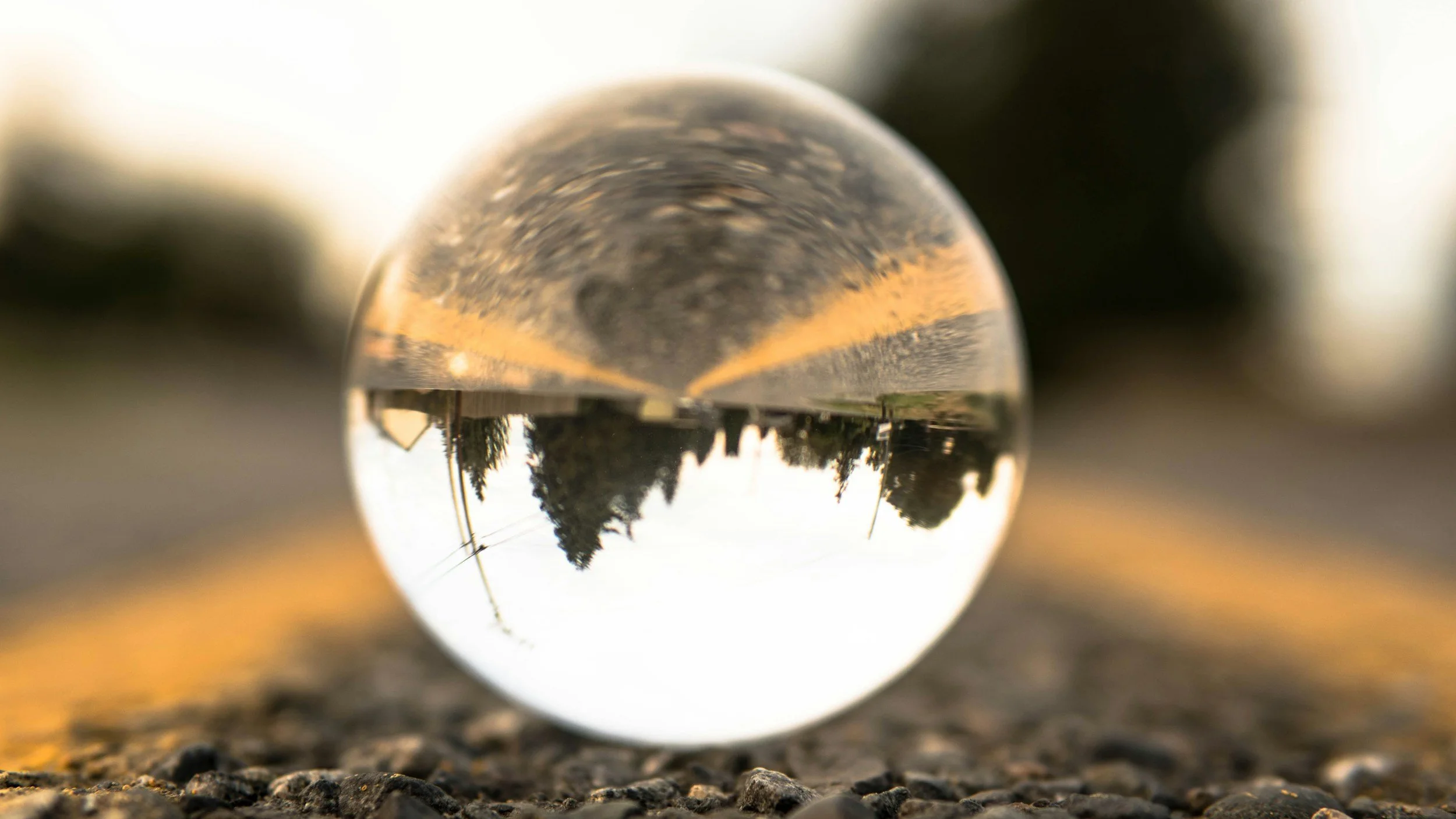
The Upside Down
The human condition. It seems to be hard for everyone. Apparently, we are distinct from other animals in that we are self-aware. That’s a step up, right? Ironically, it seems that this awareness has been inverted to be a liability rather than an upgrade. Unlike other animals, we often find ourselves in conflict and confusion with our own being, other humans, and nature itself.
On the individual level, many of us struggle to meet our most basic needs such as sleep, optimal diet, energy and health. And we are often in a battle with the most human part of ourselves - our mind and emotions. Both whirl around each other, often leading to loops and impossible dilemmas. A constant sense of dis-ease.
Between humans, love seems to be the ultimate goal, the pinnacle of our connection. But what is love, here in this world? Often it is a sense of alignment that makes us feel comfortable and safe. We feel a sense of harmony in our ability to predict mutually beneficial patterns. But when that changes, we may also find our feelings of love have changed as well. So there seems to be an undercurrent of control involved in this sense of deep affection for another.
In the world, humans are busy and appear to have mastered our environment. But if we are dropped into nature without food, water, shelter, clothing and tools, compared to any other animal we will be woefully unprepared to survive.
It is my belief that within us humans, there is a divine spark that remains after our physical body ceases to exist. Evidence of reincarnation, out of body experiences, near death experiences, remote viewing and even dreams, suggest that our body limits our conscious capacity, rather than creates it. So, in a sense, the human ‘dying’ experience might be the start of our ‘real’ life!
With all our advancements, how has ‘human’ not gotten much easier? Why does it seem like almost every large system designed to assist in the problems for which we seek resolution, often exacerbate the issue? Why does it feel like on an individual level, we all want peace, safety and connection, but on a global level, we get everything but that. Why does the world seem distinctly anti-human? And anti-world as well? Are we living in the upside down?

Inception
Alternate title: Another Framework for Understanding Karma
I was mesmerized by the movie Inception. For some reason, I had resisted watching it for 15 years. On the surface, it was because everyone who suggested I watch it with them had already seen it before, and I wanted to watch something new to both of us. But now I think that I was meant to watch it at the right time in my journey.
In 2025 I had been questioning the nature of this reality for about 2 years. I had arrived at a general Gnostic viewpoint and was fascinated with levels of reality and near death experience reports (NDEs). In one of the NDEs that I watched, an experiencer related their idea that they understood karma to be less of an external judgment wheel of “what goes around comes around” and more of an internal block, a state of holding on to limiting beliefs that impact waking reality.
And then I settled down for what I thought was a blockbuster action movie and was spellbound by the symbolism and concepts contained in Inception.
So here’s my take on how this definition of karma plays out in Inception. Dom Cobb is a man on a quest to be reunited with his children. He is locked into a reality where this is not currently possible, and he feels that this situation is out of his control. Cobb has an encounter with the energy tycoon Mr. Saito, who has the power to change this circumstance. Mr. Saito appears to assess Cobb to be of solid character, and recruits him with the first inception, an offer to clear his karma, saying, “Do you want to take a leap of faith, or become an old man, filled with regret”?
Cobb assembles his team which includes Ariadne, the “Architect”, who creates the dream labyrinth and is the pivotal character in clearing Cobb’s karma.
On each level of reality, Ariadne works to create an inception in Cobb. She plants the idea that his ongoing pain is not ‘real’, but a figment of his past that he is willingly keeping alive. As Cobb descends into increasingly slow and chaotic dream worlds, he must grapple with this new framework. He must decide, in his most inaccessible and unconscious layers, to release the mental and emotional cage in which he keeps himself bound. He must choose the mission of love for his children. If he succumbs to his guilt, pain and regret, the plan will fail. He might even get lost in the deepest levels of density, far from the level of conscious creation and never return to waking life. With Ariadne’s words of compassion, he is able to accept that the past is over and no longer real. He sees that his memory creation of the past is flawed, only the best he could do at the time. He surrenders to this insight and forgives himself and his wife. When Cobb opens his eyes as the flight prepares to descend, he awakens to a new reality. He has conviction and clarity. He is no longer using the same operating system as the one he experienced at takeoff.
Cobb walks off the airplane into an elevated life. As I watched Cobb move through the airport I was left with the surreal sensation that the return to real life was yet another level of a dream. There are many theories about this and the symbolism of the spinning top he places on the table as he turns to greet his children. It is implied that at this point in Cobb’s journey, he is content with his current reality.
How can we know where base reality resides? Is it even possible to consider this a base reality, when we dream each night, and inevitably physically cease to operate, yet science is now showing that consciousness likely continues? Does suffering in consensus reality give us the ‘kick’ we need to recognize this as just one level of endless realities, each more conscious and aligned than the one below?
Can we use inception on ourselves? Can we rewrite the movie that our memory has stored? Can we get to our base code? Which conclusions do we take so much for granted that they have been buried in our unconscious operating system? Arthur initially argues against the idea of inception with Mr. Saito, saying that core beliefs must be self-created, “the subject can always trace the genesis of the idea”. When we trace the genesis of our ideas, we may have created them, but did we have all the knowledge available to us when we put them in place?
Let’s take a “leap of faith”, and with a good team, examine the inception of our ideas. Let’s make sure that they are our own, that they reflect our current vision, and that we walk forward with clear karma into an expanded new dimension.
What are your thoughts on karma, or on optimizing levels of conscious experience? What movies or books nudged you to consider the possibility that our consensus reality might be one layer amongst many?

Royalty/the Ruling Class/the Elite/the Cabal/the .01%
Alternate title: Does the King get Norovirus?
We’ve all been there. That moment when brutal sensations that we forget our body is capable of unleashing upon us, rip through our system until we start to lose contact with our held sense of normalcy. A creeping realization sets in, that we must surrender to this turn of events, that there will be no willing it away. Where all our worldly comforts dissolve into an abyss of abstraction, our humility lowered beyond known limits. We consider the refuge in hugging the toilet, then that the bathtub might be necessary. We stop praying to our god for salvation. For a brief moment, we might pray instead for annihilation. Such is the mighty path of the stomach bug.
It seems to be part of our shared humanity, this fragility. That our body can dictate our reality, and that we are able to transcend it only but so far, attached as we are to it. It seems to always find ways to humble us. So, are all who inhabit a human shape basically the same? Are kings tempted to tap out on life after a cursed breakfast buffet? If they are, what separates them from us? Why did we hand our power over to them? I mean, way back when…back, back in time. Before it was a conditioned pattern of fatalistic inertia, “this is just how it is.” How did some individuals make the cut to be worshiped?
Right now I am considering two main frameworks to understand the nature of the ruling class and the evil that seems to ensue from their dominion over our Earth and us commoners.
The first is the viewpoint of the courageous David Icke, who shares ideas that include Gnostic philosophies, multiple dimensions of existence, infinite consciousness and perceptual guardrails (our five senses). In this view, we humans are in a contained reality that is useful to, and operated upon by entities that can access dimensions and energies outside of the range of our physical senses. These entities have the ability to shift at will into being perceived by us as human in form.
The second viewpoint is one I have recently encountered from the dynamic professor and ‘Predictive History’ YouTube channel creator Jiang Xuequin, a Yale educated teacher who uses game theory, pattern recognition and the study of hierarchies throughout history to explain our current reality. He posits that humans can become absolutely corrupt in the path to attainment of power. This power is consolidated by birthright and leveraged privilege, wealth, interpersonal networks and access to resources. But they are just regular humans. I do not like this viewpoint.
I agree with so much of what Mr. Xuequin says, regarding the history of our world’s global power structures, the strategic corruption of religion, and evidence of bloodthirsty practices stretching back to the beginning of time. From his experience in Ivy League education, he explores the idea that the “elites” have a specific type of cognitive and emotional operating systems, one that that sets them apart from us normies. When they protect one another and solidify power structurally, they have near absolute security. There is nothing left for them to do but seek novelty and excitement in the form of cruelty and subversion of those facets of human experience that are generally considered most essential: love, connection, growth and wisdom.
So in rejecting a set of ideas that make sense, I have to ask why? Of course, I have resistance to considering that a part of myself is secretly a bloodthirsty maniac. I also have to ask if it is scalable, is it efficient and optimal for humans to access true evil? It is certainly possible (see psychopathic personality, which is understood to be organic wiring more than any other factor). But is it only this type of human nature alone that has scaled to societal level? Or is something outside human nature pushing the outcomes in this direction?
In imagining a human experience with no prior programming about “original sin”, Cain killing Abel for a perceived ego slight, wars, ruler dominance, worship of non-visible beings, factory farming, subjective territorial boundaries, personal property, exploitation of nature, etc., what would arise naturally in us? At what point does evil inevitably enter the picture? What forces conspire to turn us against each other? I can imagine that violence could ensue only when resources are so scarce that survival of the child is in imminent peril and another is a direct threat to its continued existence. This would be a tragic impasse. My fellow unconditioned humans might feel the same and come together to brainstorm the least devastating options. Why have humans, with ever increasing means of access to resources, continued to turn against each other? Why has access to basic necessities been commercialized? Why are those at the top of the pyramid who reap the benefits of all the power, monetization and safety of resources, the very worst of “us”?
So I like David Icke’s theory. We are divine sparks of consciousness, down here, having a human experience, so limited in our perception that we can’t even conceptualize an infinity of options. We are trapped here in a perceptual prison, our bodies hardware that interact with the frequency field to run programs automatically (breathing, digestion), our divine mind software corrupted with their virus (eat or be eaten), with the pain of these seemingly ‘out of our control’ systems being harvested in the form of energy to sustain those who we cannot perceive. What explains the overtly anti-human nature of our current systems? What explains the ongoing human experience of low-grade fear, hopelessness and self-hatred? Are we really supposed to be here, experiencing all this? Did ‘we’ really choose this path? And why, even in moments of bliss, do we sense an undefinable longing, a sense of being lost and homesick?
What are your thoughts? Join and comment on the theory that speaks to your knowledge and experience, or the one that just keeps you sane enough to function.

Bugonia
Have you seen it? If not, I highly recommend it. Yorgos Lanthimos is incredible in creating surreal yet very human stories. The acting is on-point and the cinematography and editing is sublime, with a touch of camp gore.
Questions I have related to this movie (many spoilers below):
What role have your personal experiences had in changing your understanding of our everyday consensus reality?
Can beings outside of our human experience rule us fairly?
Can we have true empathy for those we don’t understand?
Have we been exploited into participating in corporate speak and punishing work hours (among many other things) by a consciousness outside of human experience?
What might the role of the cop who molested Teddy have in the overall story arc?
Was there any truth in Michelle’s exposition speech to Teddy about human origins?
What did you think of her framing Teddy’s actions toward his mother as willful murder when she tricked him by selling it as a cure?
Does any sympathy for Teddy’s mission change for you when it’s revealed that he is a serial killer?
Would Teddy have been able to board the ship if he had not had explosives strapped to him?
Is the human awakening to the truth the end of their rule, and our usefulness?